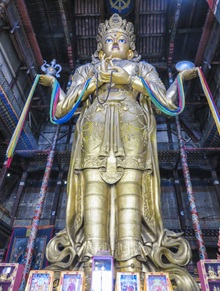
| Buddhism in Mongolia
Buddhism was introduced into Mongolia over 2,000 years ago, and despite Soviet repression
and purges 1922-1991 is considered one of the intellectual centres of Buddhism worldwide. Buddhism
is the largest religion in Mongolia, practiced by approximately 52% of the population. It primarily
follows Vajrayana Tibetan Buddhism, which has distinct characteristics influenced by local
traditions and history.
The Mongol Empire, particularly under Kublai Khan, saw a significant adoption of Tibetan Buddhism,
facilitated by the Sakya school. Kublai Khan invited lama Drogön Chögyal Phagpa to spread Buddhism
throughout his realm. Third Wave (16th Century): The Dalai Lama's school of Tibetan Buddhism gained
prominence, particularly under Altan Khan, who established it as the national religion.
|
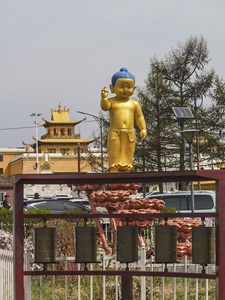
| Buddhism Tours
Whether you want to stay in a temple and meditate, attend classes, or just visit, Touring
Mongolia can cater to your needs. Mongolian Buddhism is distinct yet closely related to Tibetan
Buddhism, and is the largest religion in Mongolia.
|
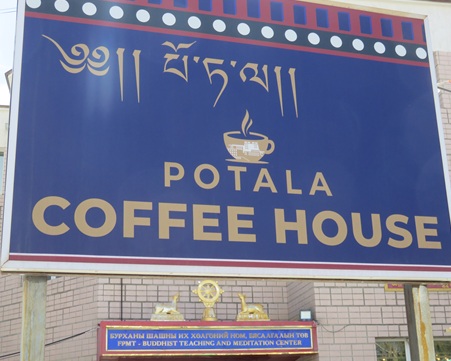
| FPMT, UlaanBaatar
The Foundation for the Preservation of the Mayahana Tradition ("FPMT") in UlaanBaatar provides
interesting lectures, as well as hosting the lovely Potala coffee shop to simply hang out.. Touring
Mongolia has the latest class schedules, taught in English, for its clients.
|
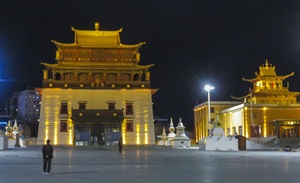
| Gandan Monastery, UlaanBaatar
The name of the monastery, Gandantegchinlen (Tibetan for "complete rejoicing"), is derived from Ganden Monastery in Tibet. Founded in 1809, Gandan was closed amid persecutions in 1939, and from 1944 to 1989 was the
country's only active monastery. The monastery has more than 100 resident monks and numerous Buddhist
treasures, including a 26-metre statue of Avalokiteśvara made of gilded bronze and precious stones.
Naagii is also full of great suggestions and recommendations, my favourite was Gandan Monastery at night!
|
|
| Choijin Lama Temple, UlaanBaatar
Built in 1908 for the brother of the last Holy Ruler of Mongolia, Bogd Khan, it consists of 5 separate temples
featuring many famous artistic and sculptural works of Mongolian artists.
|
| Aryabal Monastery, Telenj
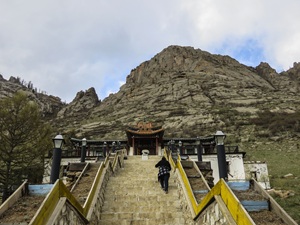
Within Gorki Terelj National Park, the Aryabal Meditation Monastery is beautifully built into the hillside
at the end of a spectatcular and scenic valley. Aryabal is a Buddhist God who listens to all the prayers of humankind and releases it from suffering. The temple is built in the shape of an elephant’s head. The stairs leading to the temple consist of 108 steps and symbolizes the elephant’s elongated trunk. Signs with
144 Buddhist teachings, written in English and Mongolian, line the sides of the path to the temple.
|
| Aglag Buteel Monastery, UlaanBaatar
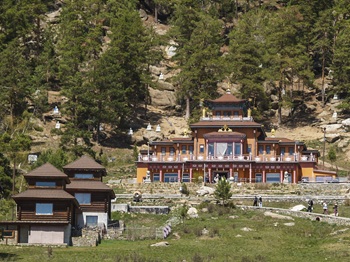
Almost 100 km north-west of Ulaanbataar on the road to the Russian boder, near the town of Bornuur
in Tuv Province, this hill-sited meditation monastery is quite beautiful and tranquil. It was
founded by the renowned Buddhist artist and lama, Purevbat. The monastery’s grounds feature a
variety of intricate carvings, historical artifacts, and majestic Buddhist statues.
|
| Erdene Zuu Monastery, Kharkhorin
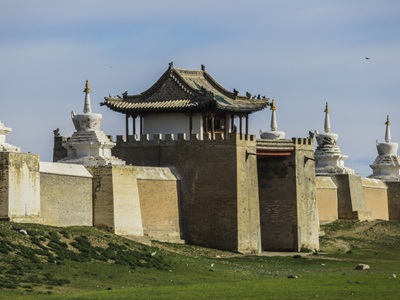
The earliest surviving Buddhist monastery in Mongolia from the late 16th Century, it is located in
Kharkhorin, the historic capital of Genghis Khan (300 km west of Ulaanbataar). Famous for its walled
108 stupas, it was built by Abtai Sain Khan, ruler of the Khalkha Mongols and grandfather of Zanabazar,
after his meeting with the 3rd Dalai Lama and the declaration of Tibetan Buddhism as the state religion of Mongolia. |


 TOURING MONGOLIA