| Mongolia - a History to surpise you!!
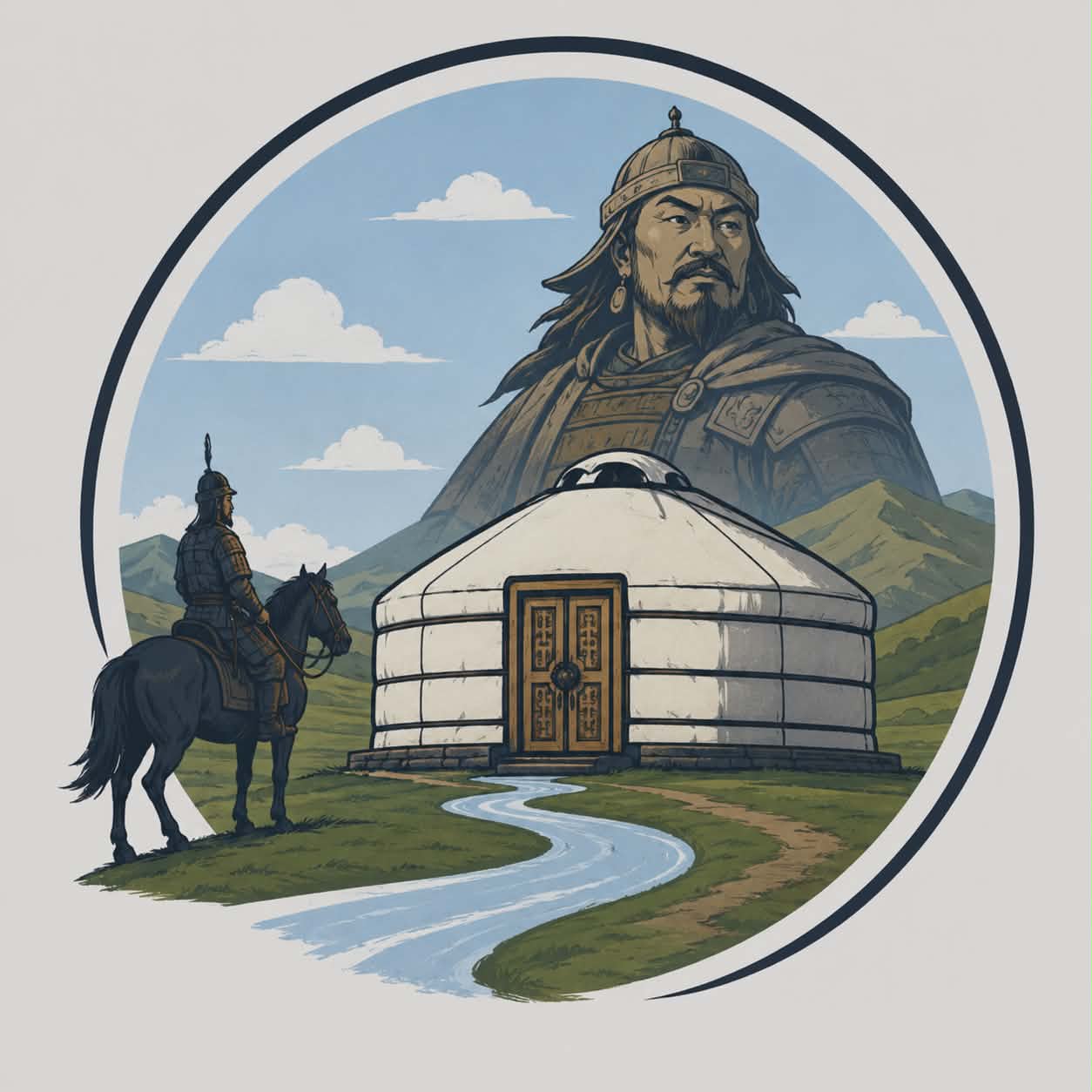
Mongolia, the "Land of Eternal Blue Sky" - once the biggest empire in the known world,
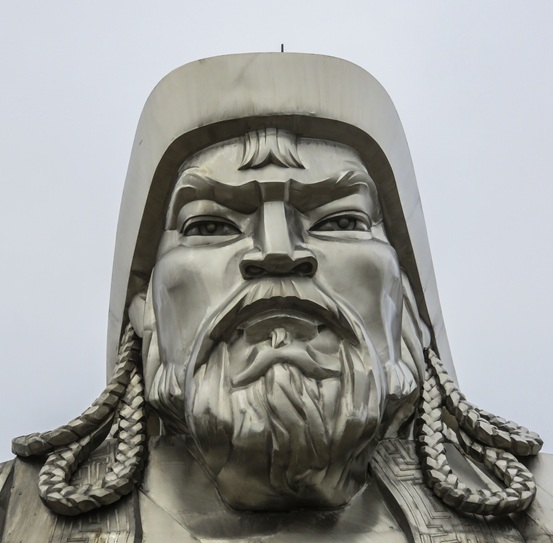
stretching from the Chinese pacific coast to Hungary and Poland. Genghis Khan ("Chinggis Khan"),
Emperor of China Kublai Khan, his foreign diplomat Marco Polo, Tamerlane - great names in world history...
Mongolian history is characterized by the rise and fall of various nomadic empires. These
tribes, including the Xiongnu and Turkic Khaganates, ruled Mongolia from ancient times. In 1206
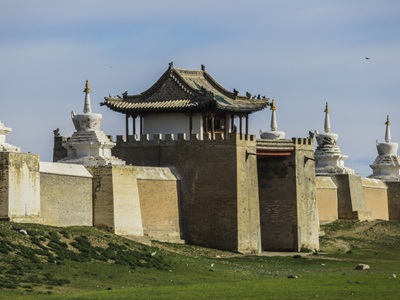
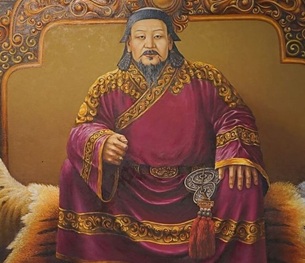
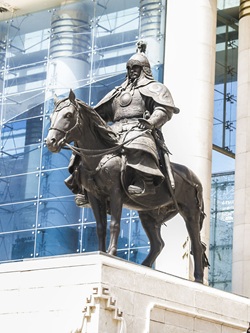
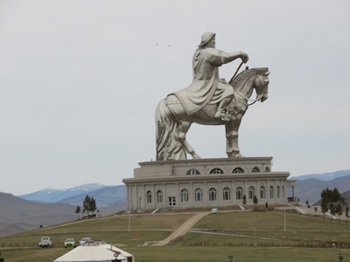
Chinggis Khan was crowned the great Khan and established the Mongol Empire. He founded Karakorum as his
capital city in 1220, the first city of Mongolia. Chinggis Khan also introduced a written script
that exists to this day.
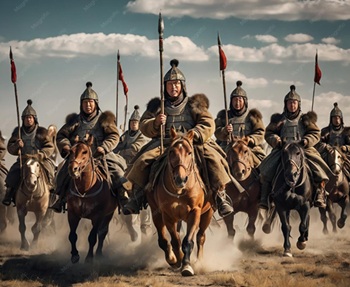
His son Ogedei Khan invaded the Middle East, Eastern Europe, capturing Kiev, Krakow, Wroclaw, Buda & Pest.
The European conquests would have continued but for his death and a convening of the Khan Council, so
his nephew Batu Khan returned to Mongolia to help elect a new Khan. Batu Khan's legacy was the Golden
Horde, dominating Eastern Europe, Russia, Ukraine, the Caucasus and Central Asia for several centuries.
Meanwhile, Batu Khan's cousin Kublai Khan established himself in the eastern part of the Mongol Empire,
re-locating his capital to Beijing and becoming the Emperor of the Yuan Dynasty of China in 1271. Kublai
also established a summer capital at Shangdu - or Xanadu, in Inner Mongolia, famously described by Marco Polo.
As Kublai expanded his empire, his attempts to invade Japan in 1274 and 1281 from recently captured Korea were
thwarted, his fleet devastated in 1281 by a "divine wind", or "kamikaze"!. After a serious of natural
disasters and a major famine, creating social unrest, the Empire was overthrown in 1368 leading to the
establishment of the Ming Dynasty in China and re-establishment of Chinese rule.
A distant heir of Chinggis Khan, Timur or Temurlane, a member of the Barlas Mongolian tribe, was born in Uzbekistan and rose to power in the mid-1350's. Timur gained control of the western Chagatai Khanate by
1370 and from there he led a series of military campaigns defeating the Khans of the Golden Horde,
the Mamluk Sultanate in Egypt and Syria, the emerging Ottoman Empire, as well as the Delhi Sultanate
in the Indian subcontinent, thus becoming the most powerful ruler in the Muslim world. Timur referred
to himself as the "Sword of Islam", and his direct descendant was Babur (1483–1530), founder of the
Mughal Empire in India.
Cities in Mongolia were completely destroyed during Ming Chinese raids in the late 14th and early
15th centuries. Mongolia encountered Russian expansion on her northern border in the 17th century. The well-armed Russian Cossacks cruelly subdued the resistance of the Buryats and conquered the Baikal region
in 1640-1650s. By 1757 Mongolia had lost all independence, and after the Qing government seized control of
Outer Mongolia, it grouped Khalkha khoshuns into 4 aimags (provinces). As vassals of Qing Emperors, the
Mongolian nobles—rulers of the khoshuns were expected to carry out military services commanding their
troops in warfare, to personally attend the Emperor in his hunting processions, mobilize resources
from the khoshun population and subdue local riots.
The 20th Century brought changes from first China then the Soviet Union - firstly, the fall of the
Qing Dynasty administered by Manchus in 1911 led to Mongolia declaring its independence, led by the
Bogd Khan ("Holy Ruler"). The Qing high official in Uliastai was deported on 12 January 1912 in the
presence of 700 Mongolian warriors. In its historical significance, the establishment of the Bogd Khaanate
of Mongolia is comparable with the foundation of the unified Mongol Empire in 1206. With national
independence, Mongolia entered the path of modernization. A parliamentary structure consisting of two
chambers, the Upper Hural and the Lower Hural, was formed in 1914. A legal code was adopted in 1915.
Following the Russian Revolution of October 1917, China revived its claims to Outer Mongolia, Russian
White Guard troops led by Baron von Ungern-Sternberg invaded Mongolia in October 1920. Ungern's troops
assaulted the capital, Niislel Khuree, known to Europeans under the name Urga (now Ulaanbaatar), several
times, but were repelled with heavy losses. The Mongolian People's Party (MPP) was established in 1921,
and the Soviet government saw this party as instrumental for driving Ungern's troops from Mongolia, and
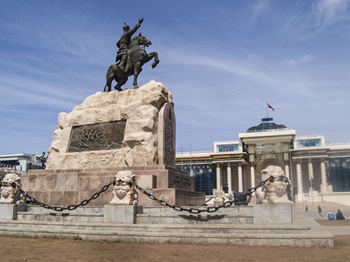
they provided military aid to the new party. The Mongolian Revolution of 1921 began on 18 March, when
400 volunteer troops led by Sukhbaatar attacked the 2,000-man Chinese garrison in Kyakhta at the
northern frontier of Mongolia. The Mongolian volunteer troops and units of the Soviet Red Army advanced
to the south, annihilating the remainder of the defeated Chinese troops and Ungern's White troops.
In 1921 Mongolia had an underdeveloped and stagnant economy based on a nomadic form and an interest in
animal husbandry. Agriculture and industry were almost non-existent; transport and communications were
primitive; banking, services and trade were almost exclusively in the hands of Chinese or other foreigners.
Most people were nomadic herders illiterate, and much of the male labour force lived in the monasteries,
contributing little to the economy. Property in the form of livestock belonged mainly to aristocrats
and monasteries; ownership of the remaining sectors of the economy was dominated by Chinese or
foreigners. Mongolia's new rulers thus faced a major task in building a modern economy.
After the mysterious death of Bogd Khan in 1924, the MPP moved quickly to promulgate a Soviet-style
constitution, abolishing monarchy and declaring the Mongolian People's Republic on 26 November 1924.
Mongolia became completely isolated from the world by the MPP government, which followed the Soviet
Union in implementing the Communist experiment. On the other hand, this also provided protection
against the potential aggression of China. In 1939, Soviet and Mongolian troops fought against Japan
in the Battle of Khalkhyn Gol, in Eastern Mongolia. In August 1945, at the end of World War II,
Mongolian troops took part in the Soviet operations against Japan in Inner Mongolia. The Soviet Union
officially recognized Mongolian independence in 1945. Also in August 1945, the Republic of China finally
agreed to recognize Mongolia's independence after a 100% voting support for it. When the Sino-Soviet
split developed in the 1960s, it aligned itself firmly with the Soviet Union. In 1960, Mongolia gained
a seat in the UN.
As the Soviet Union collapsed, the first democratic election was held in July 1990. The Mongolian
People's Republic officially ceased to exist on 13 February 1992. Mongolia faced the need to transition
to a market economy, with past economic dependency on the Soviet Union at an end. The shift to a market
economy began, accompanied by difficulties such as high inflation and unemployment. Mongolians began
actively reviving their cultural traditions, including histiry, music, dance, and art. Chinggis Khan
was re-introduced into education and culture, and the restoration of interest in the Mongolian language
and literature became an important element of cultural revival. Mongolia began to develop its tourism
sector, drawing attention to its cultural heritage and natural beauty.
|


 TOURING MONGOLIA